Review: ProTraverse Ultra-lightweight Transfer Chair
I miss walking. Before my spinal cord injury, walking was the only form of exercise I actually enjoyed. My electric trike has given me back much of that enjoyment. On my trike, I can be outside, talk to neighbors, walk my dog, and talk with Chris eye-to-eye on an evening stroll.
What I miss is the freedom to move without intentionally thinking through each step. Sometimes, while Chris runs an errand, I’ll sit in the car and watch people walking down the sidewalk. They look ahead or at the person walking beside them. They lick ice cream cones and hold a child’s hand. They juggle bags in each hand. They pivot and walk in the opposite direction. They walk confident their legs will hold them and carry them wherever their day may take them.
They walk carefree.
I miss that.
I don’t miss waiting in line. I can’t do it, and I don’t miss it.
However, sometimes, I need to do both, walk and wait in line. And that’s a problem.
So, we bought a transfer chair.
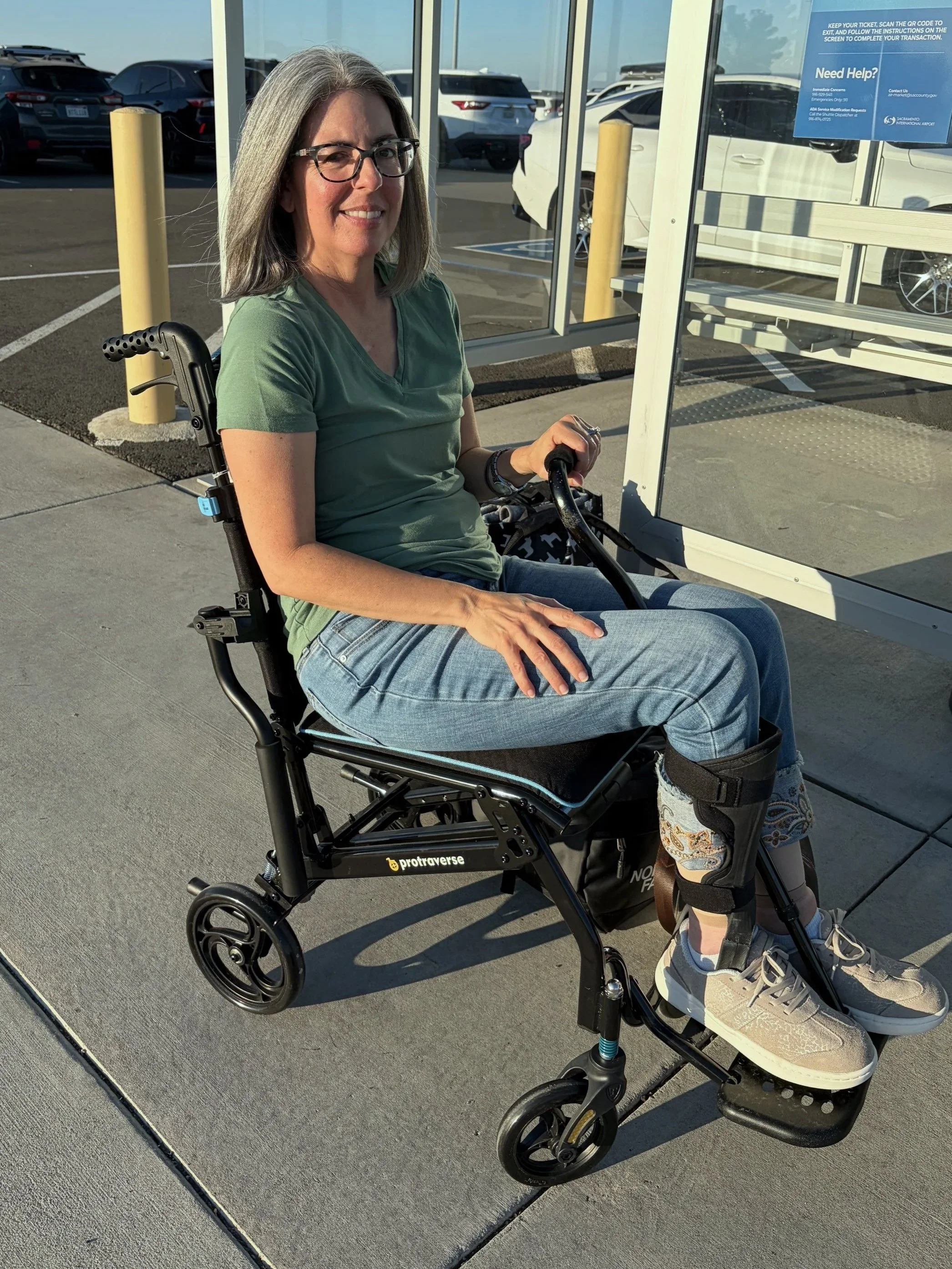
What’s a transfer chair?
A transfer chair is similar to a wheelchair, and it’s okay if you want to call it that. A transfer chair does not have the hip-high wheels that can be turned with your hands. It must be pushed by someone else. So, in my transfer chair, you can transport me somewhere, but I cannot transport myself. Make sense?
A transfer chair is often light, transportable, and narrow. It easily folds to fit in the back of your car (or backseat). Narrow enough to enter and exit most doorways. It’s handy.
We shopped for a long while before choosing my transfer chair. Then we took it on a few flights, a bus, a boat, and a cruise ship. We rolled it through smooth airport terminals and across gravel hillsides. It performed like a champ.
ProTraverse Ultra-Lightweight Transfer Chair
We bought the ProTravers Ultralightweight Transfer Chair. Here’s why.
Pros:
Folds easily
Lightweight
Adjustable (telescoping) handles to fit the heights of different caregivers
Brakes
A footrest that folds out of place if you don’t need it
A footrest that places feet together in the center, not separate to the sides.
A pocket in the back (handy for holding a strap…read further)
Spring suspension (slight, but nice)
Flip up armrests (so nice to flip those out of the way)
Seatbelt (we removed it and turned it into a locking strap, see below)
Cons:
Doesn’t clip closed when it’s folded. (We used the seatbelt, which is a wide, backpack-style strap, and carried it in the pocket when it wasn’t in use.)
No color choices. Blue is what you get.
My Rating
4 out of 5 stars. I would have given it a higher rating if the back wheels were larger, more off-road-ish, and if it locked in the folded position. A completely nice-to-have but not necessary option would have been a cupholder.
Travel Tip with any transfer chair or wheelchair
I always use the airport’s wheelchair assistance. But, since we wanted to gate-check my chair, we used my transfer chair at the airport instead of asking for the airport’s wheelchair service. The airport personnel treated me with the same help and respect. My husband was able to push me and one roller suitcase while I held/pushed the other roller suitcase at my side. At the gate, they let me stay in my chair all the way to the plane. Then they gate-checked it which meant the chair was at the plane (in the gangway) waiting for me when we deplaned. They handled it carefully, but don’t count on that. Strap it down as best you can so nothing is loose.
I send subscribers a monthly newsletter packed with updates and links they’ll enjoy.
Subscribe and I’ll send you a list of verses to help you endure.



We shopped for a long while before choosing my transfer chair. Then we took it on a few flights, a bus, a boat, and a cruise ship. We rolled it through smooth airport terminals and across gravel hillsides. It performed like a champ. We bought the ProTravers Ultralightweight Transfer Chair. Here’s why, the pros and cons, and my rating.